From the first principles to the systems you build. A clear three-phase journey: self-paced modules, a focused founder-led build session, and assessments that turn learning into demonstrated capability.
Research depth. Practical teaching.MIT & Purdue PhDsFounder-created coursesLearn · Build · DemonstrateA structured enterprise journey12 learning tracksFrom fluency to AI systems
01 / YOUR TEAM’S LEARNING JOURNEY
What our training looks like.
Everyone arrives prepared. Then we build together. Finally, each learner demonstrates what they can do. Here is exactly how the three phases fit together.
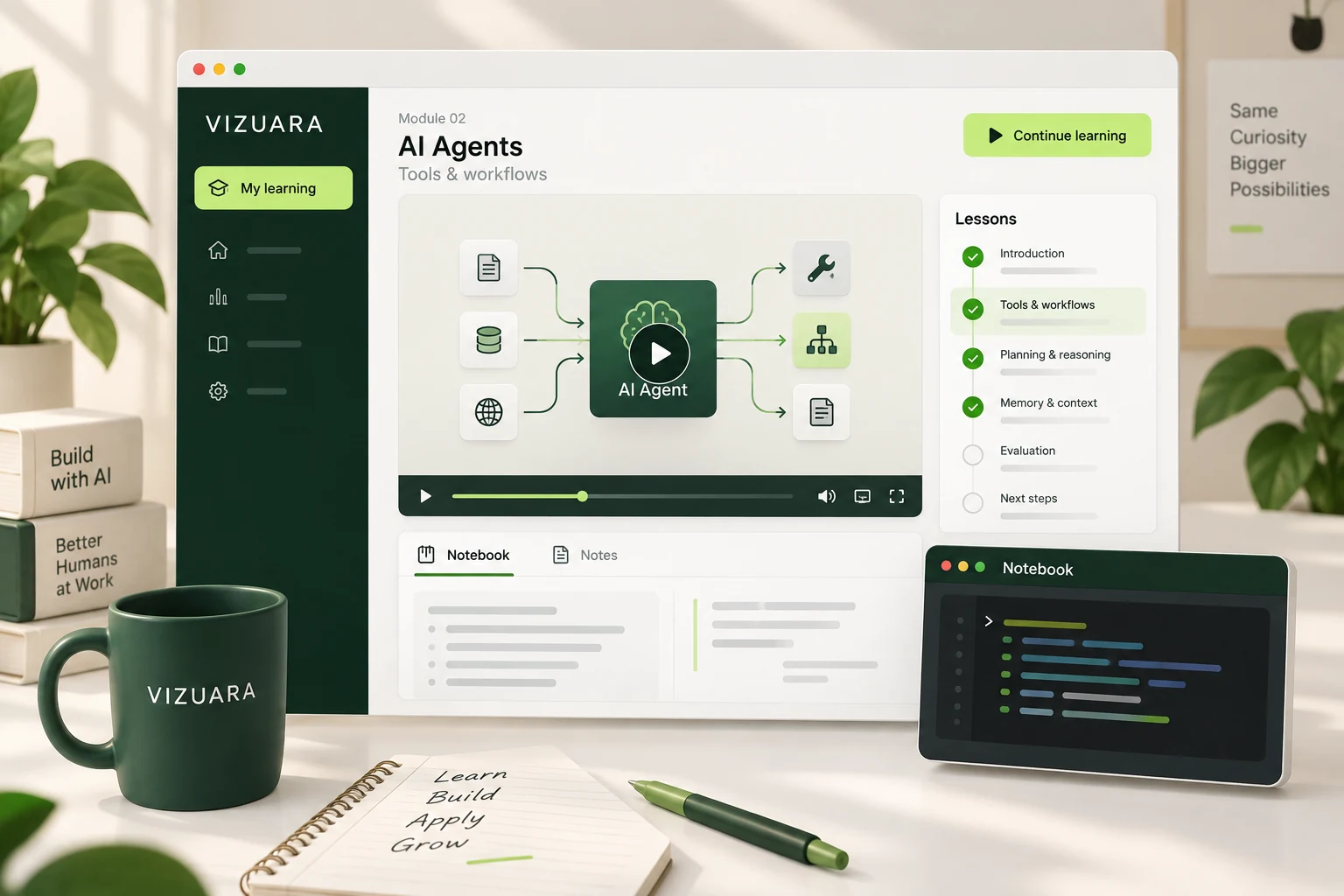
PHASE 01THE LEARNING WORKSPACE
Illustrative learning workspace · Course content varies by program.
01 / SELF-PACED LEARNING
A common foundation, built around your workday.
Each learner gets access to the selected Vizuara courses. Your team works through the modules before the practical session, so everyone arrives with the vocabulary and starting skills to build.
Watch a module.Follow a recorded explanation with visual intuition, worked examples and code walkthroughs. Pause and replay the parts you need.
Open the notebook and try it.Run the accompanying code where provided, change an input, and observe how the result changes. Use the notes to revisit the reasoning.
Bring a question or a use case.Keep a short list of doubts and an idea you want to explore. Complete the agreed preparatory modules before the founder session.
What your team has at the end
A shared foundation, completed practice and a concrete set of questions for the build session.
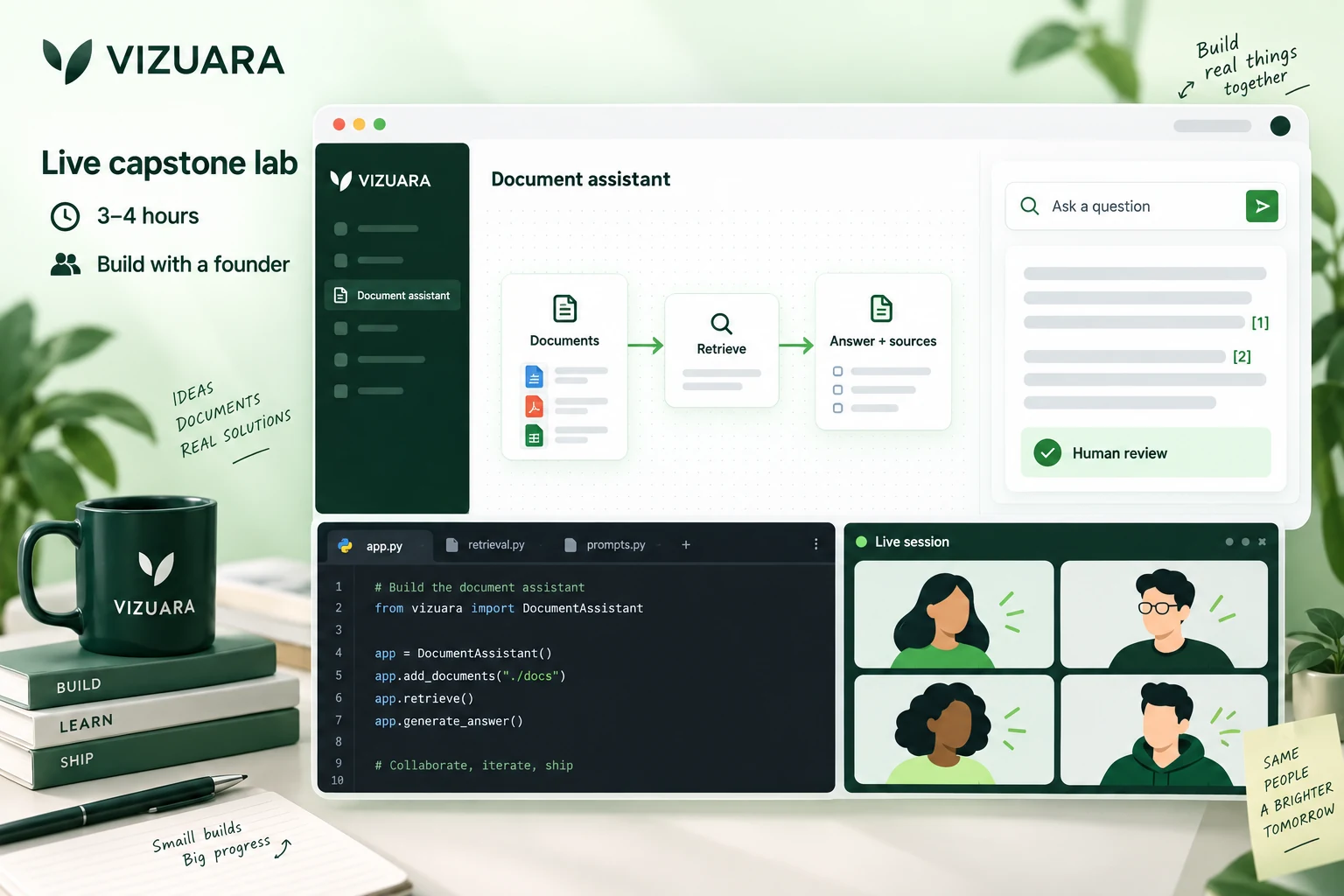
PHASE 02THE FOUNDER-LED BUILD
Example capstone: an evidence-backed document assistant.
02 / LIVE PRACTICAL SESSION · 3–4 HOURS
Build a working capstone. With a founder, step by step.
A focused live session connects the self-paced modules to a complete project. A Vizuara founder explains the design choices, builds the workflow and helps participants work through the implementation.
Start from the problem.Agree what the system should do, sketch its architecture and define a small set of success criteria.
Build alongside the founder.Follow the implementation, run the workflow, ask questions and debug the pieces together.
Test it, then extend it.Try difficult inputs, discuss failure cases and identify what each learner should improve in their own capstone submission.
What your team has at the end
A working project baseline, an explanation of the key decisions and a clear next step for independent project work.
INSIDE A 3½-HOUR BUILD SESSION
A practical session, from blank page to working demo.
Illustrative agenda. Timing and project are tailored to the selected track.
30 MINFrame the problem
Use case, architecture and success criteria.
90 MINBuild together
Implement the workflow with guided coding.
45 MINTest and improve
Debug, evaluate and inspect failure cases.
45 MINDemo and discuss
Review the result, questions and next steps.
WHAT COULD YOUR TEAM BUILD?
Real engineering decisions. A concrete project to show.
We select the practical exercise to match the course and the team’s starting point.
AGENTS + CONTEXT
A document assistant
Retrieve from an approved document set, answer with citations and route uncertain responses for human review.
Explore: retrieval quality, tool use and grounded answers.SLM ENGINEERING
A domain-specific small model
Adapt a small model on a prepared sample dataset and compare its responses against a baseline.
Explore: data quality, adaptation and evaluation.INFERENCE ENGINEERING
A measured serving pipeline
Run a prepared serving setup, benchmark latency and throughput, and investigate an optimization.
Explore: batching, memory and quality trade-offs.
Examples are scoped for a 3–4-hour lab with prepared data and environments. Full model pretraining and production rollout continue beyond the session.
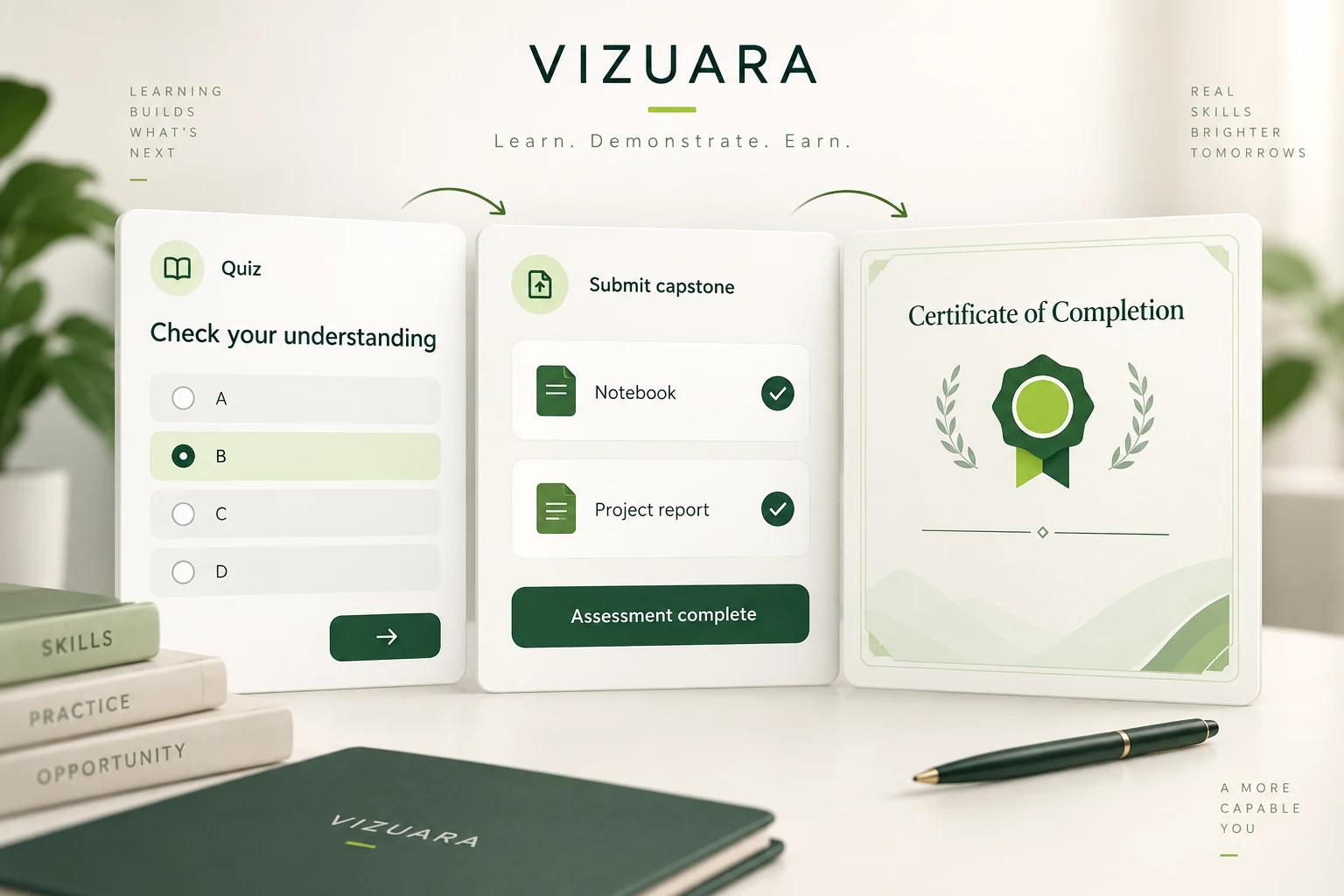
PHASE 03THE EVIDENCE OF LEARNING
Illustrative assessment and certificate · Awarded after successful completion.
03 / ASSESSMENTS + CERTIFICATION
Show what you understand. And what you can build.
After the practical session, learners complete the assigned work and demonstrate their own understanding. Certification recognizes successful completion of the required assessments and capstone.
Check the concepts.Complete the course’s applicable quizzes or assignments to test understanding of the ideas and implementation choices.
Submit the capstone.Develop the project further and submit the required artifacts, such as a notebook, demo, short report and evaluation results.
Meet the completion criteria.The submission is assessed against the agreed requirements. Learners earn certification after completing the required assessments and capstone successfully.
What your team has at the end
Evidence of applied learning: completed assessments, a capstone submission and certification for successful learners.
Before the cohort begins, we agree the course selection, preparation, founder-session date, capstone scope and assessment requirements. Course-only licenses are also available; the proposal distinguishes these from the complete enterprise program.
Choose the skills your team needs now. Combine foundations, applied AI and specialist systems courses into a focused learning plan.
EXPLORE OUR EXPANDED OFFERING
01
MODEL ENGINEERING
SLM Engineering
Build a small language model from raw data to a deployed endpoint. Understand every stage, then adapt it to an enterprise use case.
02
PRODUCTION SYSTEMS
Inference Engineering
A systems course on the full LLM inference stack: tokenization, KV cache, quantization, speculative decoding, FlashAttention, serving engines, edge deployment, and evals.
03
APPLIED AI
AI Agents
A practical agent track for teams that want LLM systems to take actions, call tools, reason over state, and automate repeatable workflows.
12 programs · Corporate learning pathways
AI systemsTechnical
SLM Engineering
Build a small language model from raw data to a deployed endpoint. Understand every stage, then adapt it to an enterprise use case.
Designed forML engineers, data scientists and teams building domain-specific models.
Applied AIMixed
Context Engineering
A hands-on workshop for building production-grade AI agents through retrieval, tool orchestration, memory, context compression, and observability.
Designed forEngineers, analytics teams, product teams, and managers who need a practical vocabulary for AI systems.
Applied AITechnical
Claude Code Software Development
A practical course on AI-assisted software development, coding agents, MCP, secure vibe coding, testing, deployment, and DevOps.
Designed forEngineering teams, tech leads, QA teams, platform teams, and product engineers.
Applied AITechnical
Harness Engineering
Study the runtime around an agent: tools, context, execution, feedback and evaluation. Build systems that can be tested and improved.
Designed forSoftware engineers, agent builders and technical leads.
Applied AIMixed
AI Agents & Workflow Automation
A practical agent track for teams that want LLM systems to take actions, call tools, reason over state, and automate repeatable workflows.
Designed forBusiness teams, operations teams, software teams, and AI transformation groups.
Applied AITechnical
RAG + Fine-Tuning
A production-oriented track covering document ingestion, retrieval architecture, embedding quality, instruction fine-tuning, and evaluation.
Designed forTeams building document Q&A, research assistants, support copilots, policy search, and internal knowledge systems.
AI systemsTechnical
Build LLM from Scratch
A first-principles course for engineers who need to understand tokenization, embeddings, self-attention, transformers, training, and fine-tuning.
Designed forEngineers who will own LLM systems, architecture reviews, model selection, and technical strategy.
AI systemsTechnical
VLA Transformers
A specialist track on transformer-based vision-language-action systems: perception, language grounding, multimodal fusion, and action/control pipelines.
Designed forVision AI, robotics, autonomous systems, edge AI, and applied transformer teams.
AI systemsTechnical
Inference Engineering
A systems course on the full LLM inference stack: tokenization, KV cache, quantization, speculative decoding, FlashAttention, serving engines, edge deployment, and evals.
Designed forPlatform, backend, ML engineering, AI infrastructure, and architecture teams.
AI systemsTechnical
Robotics and World Models
A specialist track covering robot learning, Diffusion Policy, VLA models, world models, SO-101 robot-arm deployment, and autonomous systems.
Designed forR&D teams, innovation labs, edge AI groups, robotics groups, and advanced technical cohorts.
AI systemsTechnical
Parallelism
A deep systems course covering data, tensor, pipeline, sequence/context, and expert parallelism for training and serving frontier AI models.
Designed forAI infrastructure teams, systems engineers, GPU engineers, and high-performing ML engineers.
FoundationsNon-Technical
AI Fluency
A broad modern AI orientation for non-technical and semi-technical teams: what AI can do, what it cannot do, where risk sits, and how to identify good use cases.
Designed forNon-technical staff, managers, support teams, analysts, HR, operations, and compliance-adjacent teams.
A COMMON ENTERPRISE STARTING POINT
GenAI Fundamentals Bundle + Enterprise SLM
Build shared generative AI foundations, then deepen the model-building skills of your technical team. Ask for selected-course licenses for your initial cohort and a plan for additional learners.
Selected-course licenses: GenAI ₹75,000 + Enterprise SLM ₹55,000 before discount. The complete enterprise program, including the founder-led lab, is scoped separately. Tax treatment and invoice terms are confirmed in your proposal.
Course pages may describe their original public live cohorts. Corporate delivery, included materials and access are governed by your written proposal, not those historical schedules.
03 / CHOOSE A STARTING POINT
A pathway for the work you want to do.
Suggested combinations, tailored to your team’s starting point. The final course selection and pace are agreed with you.
Business & domain teams
Develop a shared language for AI.
AI Fluency → Context Engineering → AI Agents
Identify useful workflows, define success criteria and recognize when human judgment is essential.
Understand the lifecycle from model training to deployment, including quality, memory, latency and cost.
EXAMPLE: FINANCE, RISK & COMPLIANCE
A shared foundation. Different depths.
Domain specialists can define the workflow, risks and review criteria. Engineers can build retrieval, tools and evaluation around it. A suitable practice project is a document-analysis assistant using public or synthetic material, with source citations and human review before any decision.
An illustrative learning project, not a claim of regulatory compliance or a production-ready financial decision system.
04 / MEET YOUR INSTRUCTORS
Learn from the founders.
Research training, practical engineering and a commitment to explaining the details. Learn through their recorded modules, then connect those ideas to implementation in a founder-led enterprise build session.
CO-FOUNDER, VIZUARA AI LABS
Dr. Raj Dandekar
MIT PhD · IIT Madras
LLMs, inference engineering and GPU systems
CO-FOUNDER, VIZUARA AI LABS
Dr. Rajat Dandekar
Purdue PhD · IIT Madras
Reinforcement learning, reasoning and agentic systems
CO-FOUNDER, VIZUARA AI LABS
Dr. Sreedath Panat
MIT PhD · IIT Madras
SLM engineering, machine learning and computer vision
EXPERIENCE THE TEACHING
Start with a sample lesson.
Get a feel for the explanation, depth and pace before choosing a program.
Licenses, support, live availability and everything in between.
What can we buy: a course, a bundle or the whole platform?+
Corporate licenses cover the courses or bundles named in your proposal. For example, a team can combine the GenAI Fundamentals Bundle with Enterprise SLM. Platform-wide access is not included by default; tell us if that is a requirement so we can confirm the available scope.
How long do learners have access?+
Our current selected-course corporate offering provides lifetime access to the purchased courses. Your proposal will list the exact courses, licensed learners and access terms. This does not imply access to every future course or live cohort.
Are assessments, projects and certificates included?+
Selected corporate programs include assessments and capstone projects. Certification is awarded after successful completion of the required assessments and capstone, rather than simply watching the lessons. The exact requirements are confirmed for each selected course.
How does the founder-led practical session work?+
The enterprise training journey includes a focused 3–4-hour practical session after the self-paced preparation. A Vizuara founder guides the team through building, testing and discussing a capstone project. Your proposal confirms the project, delivery mode, date, cohort size and preparation. A course-only license does not automatically include this session.
What support will our team receive?+
The three-phase enterprise program combines course materials, a founder-led practical session, assessments and a capstone. Your proposal specifies the support channel, submission and review process, and any cohort reporting. Ongoing one-to-one mentorship or extra sessions can be discussed separately.
How are corporate programs priced?+
Pricing is based on the number of learner licenses and the selected courses or bundles. Request a written quote for your cohort. We offer a 7% enterprise discount on the selected course fees; the written proposal confirms eligibility and the final scope. We do not publish a blanket price for custom engagements.
Can we begin with 15–30 learners and add people later?+
Tell us your initial cohort size and expected additions. We will quote the selected licenses and confirm the terms for incremental seats. Seat transfers, shared logins and unlimited enrollment are not assumed.
Do you provide company-specific projects or progress reports?+
We can discuss how the course projects map to your goals. Bespoke datasets, custom assignments, consolidated sponsor reports, LMS integrations and additional reviews must be scoped in the proposal. Start with public or synthetic data until your organization approves other data use.
Are GPU compute, software subscriptions and API credits included?+
These depend on the course and are not automatically included in a corporate license. We will identify the required tools, hardware, accounts and any separate costs before your team starts.
LET’S BUILD YOUR LEARNING PLAN
What does your team want to build next?
Share your goals, learner count and preferred courses. We’ll use those details to scope the right licenses and a written proposal.